Accepted · APSys 2026
Unlocking Software-defined GPU Fabric Scheduling in the LLM Era
Overview
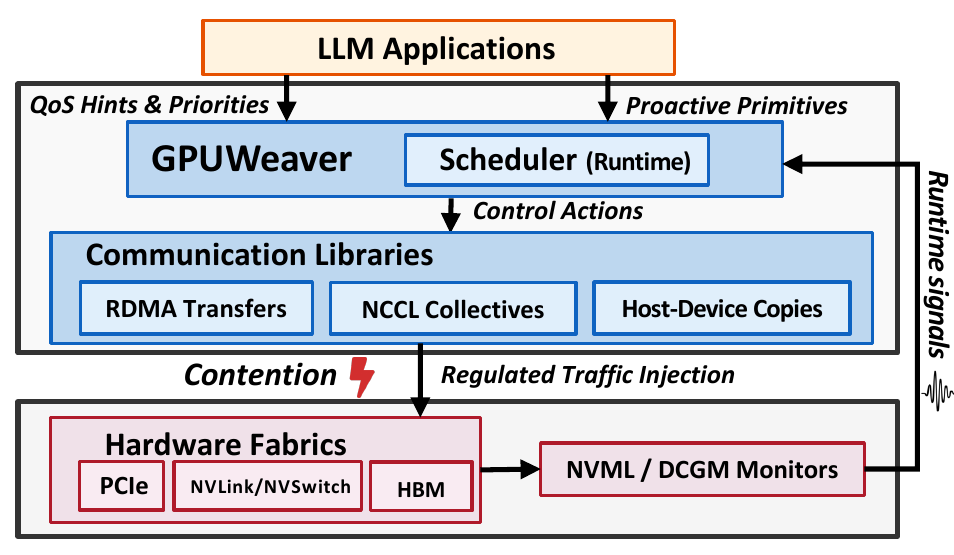
GPUWeaver explores software-defined GPU fabric scheduling for large language model systems. The paper examines contention across NVLink, PCIe, and RDMA when workloads combine computation, communication, KV-cache offloading, and disaggregated serving.
Method
A context-aware scheduler monitors application progress and fabric state, detects contention, and regulates communication injection according to application performance goals. The design treats GPU fabric bandwidth as an explicitly managed resource.
Evaluation
The study characterizes NVLink–memory and PCIe traffic interference. In a vLLM + Mooncake case study with Qwen3-8B, the prototype reduces prefill-to-decode KV-transfer time by 19.4–34.4% and mean time to first token by 2.4–6.1% across the evaluated request shapes.
| Prompt tokens × concurrent requests | KV volume | KV-transfer time reduction | Time-to-first-token reduction |
|---|---|---|---|
| 8K × 1 | 1.2 GB | 19% | 6.1% |
| 16K × 1 | 2.4 GB | 20% | 2.8% |
| 16K × 2 | 4.7 GB | 34% | 2.7% |
| 16K × 3 | 7.1 GB | 33% | 3.0% |
| 8K × 8 | 9.4 GB | 31% | 2.4% |
- GPU scheduling
- NVLink
- PCIe
- RDMA
- LLM systems
- communication contention
Citation
@inproceedings{chen2026unlocking,
  title={Unlocking Software-defined GPU Fabric Scheduling in the LLM Era},
  author={Danyang Chen and Yufeng Gu and Yibo Huang and Chengxuan Pei and Peichun Hua and Yang Zhou and Yunming Xiao},
  booktitle={ACM SIGOPS Asia-Pacific Workshop on Systems (APSys)},
  year={2026},
  organization={ACM}
}