arXiv preprint · 2026
Matryoshka Hash Representations for Model-Aware Compact Semantic Retrieval
Overview
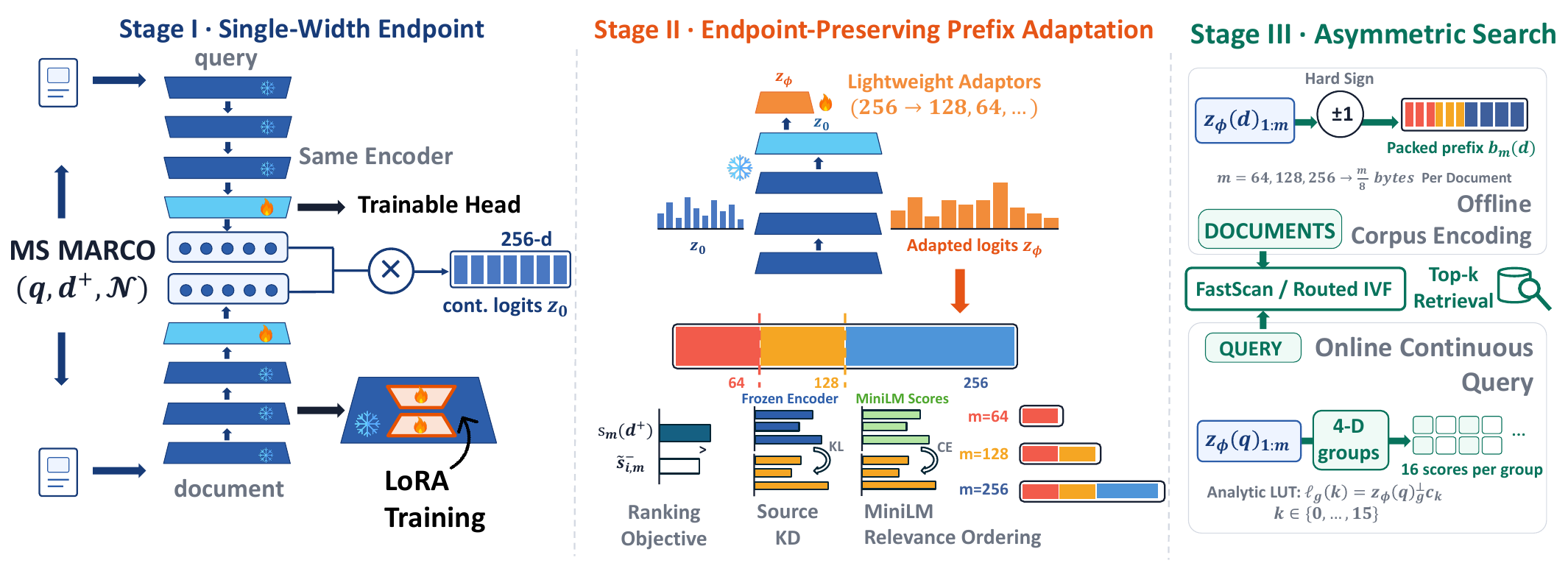
Matryoshka Hash Representations (MHR) learns compact binary document codes for semantic search and retrieval-augmented generation. One stored code supports multiple directly searchable prefix lengths, allowing a system to adjust its storage–quality trade-off without re-encoding the corpus.
Method
MHR first trains a full-width, ranking-aware binary representation, then freezes that model and learns zero-initialized residual code adaptors for shorter prefixes. Documents use one bit per coordinate; queries retain continuous logits. A FAISS FastScan implementation supports efficient asymmetric scoring.
Evaluation
Trained on MS MARCO and evaluated by zero-shot transfer to seven BEIR datasets, MHR reports NDCG@10 of 0.5561 and Recall@100 of 0.6535 at 32 bytes per document, compared with 0.5239 and 0.6426 for the best evaluated same-budget baseline. The paper also evaluates candidate shortlisting and low-storage graph-index pruning.
| Method | 8 bytes | 16 bytes | 32 bytes |
|---|---|---|---|
| PQ | 0.045 / 0.156 | 0.217 / 0.395 | 0.429 / 0.593 |
| OPQ | 0.090 / 0.226 | 0.232 / 0.423 | 0.430 / 0.597 |
| JPQ-FT | 0.217 / 0.342 | 0.404 / 0.537 | 0.524 / 0.638 |
| JPQ-Nested | 0.188 / 0.324 | 0.355 / 0.516 | 0.524 / 0.643 |
| MHR | 0.376 / 0.518 | 0.502 / 0.616 | 0.556 / 0.653 |
- dense retrieval
- vector compression
- binary hashing
- Matryoshka representations
- RAG
- FAISS FastScan
Citation
@misc{hua2026matryoshka,
      title={Matryoshka Hash Representations for Model-Aware Compact Semantic Retrieval},
      author={Peichun Hua and Yunming Xiao},
      year={2026},
      eprint={2609.07276},
      archivePrefix={arXiv},
      primaryClass={cs.IR},
      url={https://arxiv.org/abs/2609.07276},
}