arXiv preprint · 2026
Pointing the Way, Hiding the Destination: Practical Private Dense Retrieval at Scale
Overview
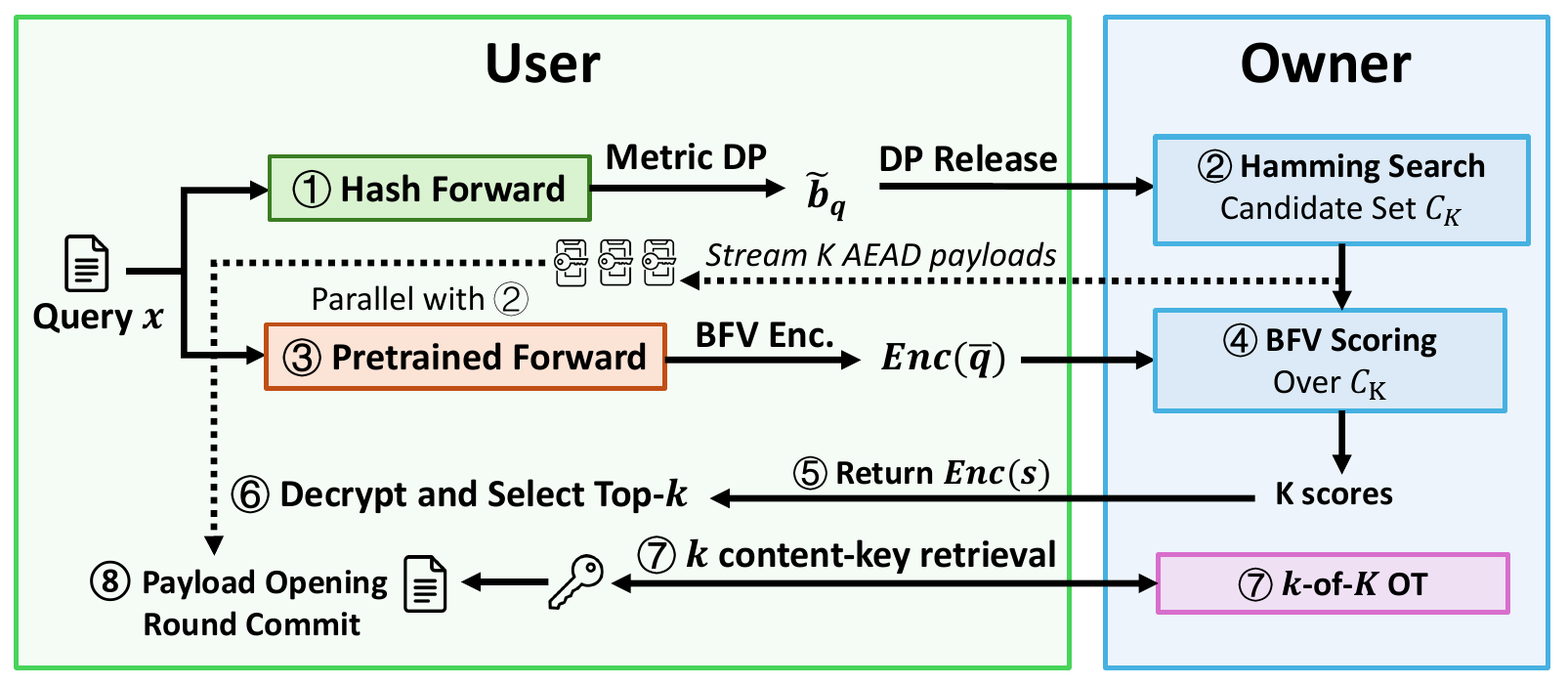
This paper studies private retrieval over a provider-held corpus: a user should obtain authorized results while protecting the query and final selection. A learned binary filter reduces cryptographic search to a compact candidate set.
Method
The user releases a randomized hash code under directional metric differential privacy. The provider builds a Hamming shortlist, scores candidates with packed BFV homomorphic encryption, and uses oblivious key transfer to release only the selected document payloads. The design explicitly permits a coarse, privacy-controlled candidate pattern.
Evaluation
Shortlists of 200–500 candidates closely match full-corpus retrieval across five zero-shot corpora spanning 25K–5.4M documents. On the 2.68M-passage Natural Questions corpus over a 10 Gbps link, the evaluated protocol adds 0.73 seconds, or 10%, to a 128-token Qwen3-32B RAG pipeline. The paper separately evaluates privacy–utility trade-offs under randomized releases.
| Corpus | Documents | NDCG@10, K = 200 | NDCG@10, K = 500 | Full-corpus NDCG@10 |
|---|---|---|---|---|
| SciDocs | 25K | 0.1875 | 0.1874 | 0.1870 |
| Natural Questions | 2.7M | 0.5723 | 0.5787 | 0.5854 |
| DBpedia-Entity | 4.6M | 0.4144 | 0.4224 | 0.4271 |
| Climate-FEVER | 5.4M | 0.2818 | 0.2785 | 0.2627 |
| FEVER | 5.4M | 0.8417 | 0.8451 | 0.8501 |
- private retrieval
- homomorphic encryption
- oblivious transfer
- differential privacy
- deep hashing
- RAG
Citation
@misc{hua2026pointing,
  title={Pointing the Way, Hiding the Destination: Practical Private Dense Retrieval at Scale},
  author={Peichun Hua and Danyang Chen and Junan Zhang and Haifeng Sun and Jingyu Wang and Diwen Xue and Mingyu Li and Yunming Xiao},
  year={2026},
  eprint={2608.25735},
  archivePrefix={arXiv},
  primaryClass={cs.CR},
  url={https://arxiv.org/abs/2608.25735}
}