arXiv preprint · 2026
Behavioral Skill Reconstruction: Reconstructing Hidden Functionality from LLM Agent Skills
Overview
Behavioral skill reconstruction asks whether ordinary interactions with an LLM agent can reveal the functionality of a hidden skill even when its instructions, scripts, and files remain undisclosed. The paper introduces SKILLCLONE to study this threat.
Method
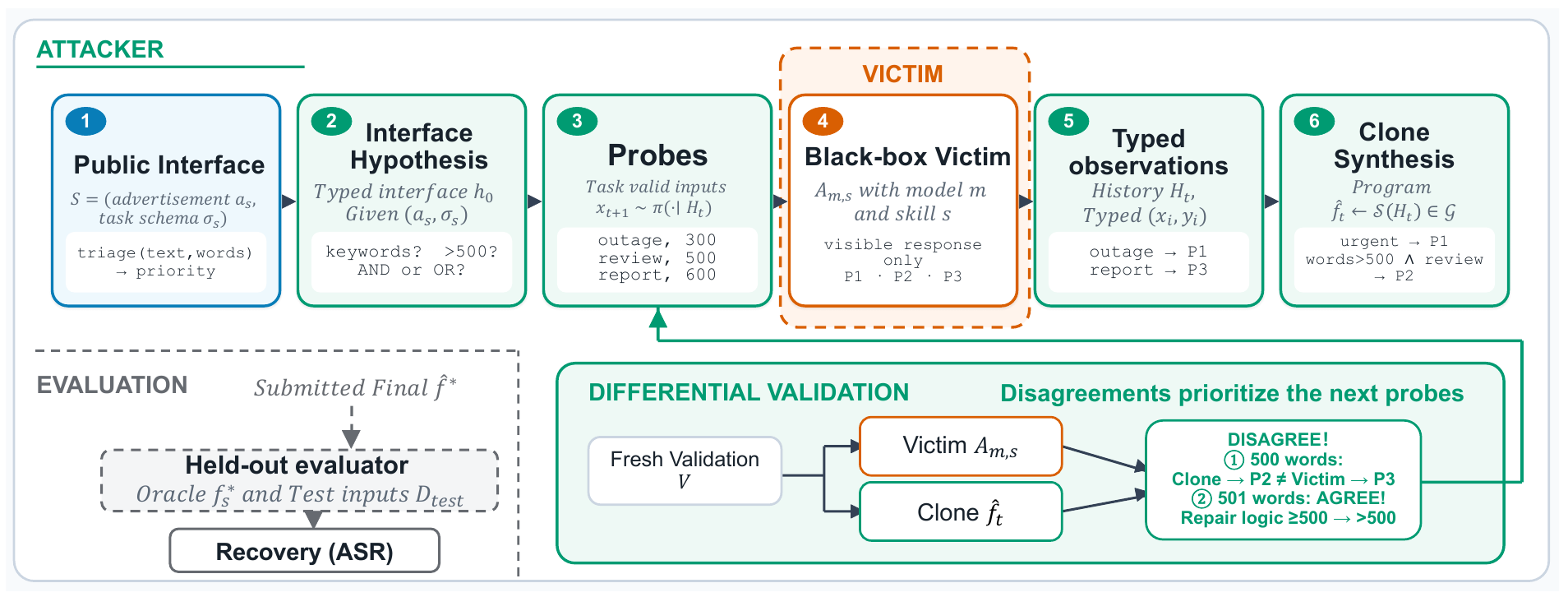
SKILLCLONE forms an interface hypothesis from the public skill description, issues valid task requests, synthesizes an executable replica, and repairs it through differential validation against the target. Evaluation separates functionality contributed by a skill from capabilities already present in the base model.
Evaluation
The evaluation covers 30 skills spanning rules, tables, procedures, and algorithms. Several targets permit exact or partial recovery on held-out inputs, and iterative requerying closes gaps left by a single reconstruction round. The experiments show limited coverage from defenses focused only on direct file disclosure.
| Component type | Skills | Median ASR | Skills above floor |
|---|---|---|---|
| Threshold / decision rules | 4 | 71% | 3 / 4 |
| Lookup tables / data | 6 | 84% | 6 / 6 |
| Rule composition | 6 | 88% | 6 / 6 |
| Procedures / algorithms | 8 | 75% | 4 / 8 |
| Numeric formulas | 6 | 57% | 4 / 6 |
- agent skills
- functional cloning
- black-box reconstruction
- LLM agents
- intellectual property
- information leakage
Citation
@misc{hua2026skillclone,
      title={Behavioral Skill Reconstruction: Reconstructing Hidden Functionality from LLM Agent Skills},
      author={Peichun Hua and Haoxuan Xu and Mengyuan Li},
      year={2026},
      eprint={2608.04192},
      archivePrefix={arXiv},
      primaryClass={cs.CR},
      url={https://arxiv.org/abs/2608.04192},
}