arXiv preprint · 2026
Tessera: Structure-Completed Evidence Units for Web Retrieval-Augmented Generation
Summary
Tessera raises answer accuracy in web retrieval-augmented generation (RAG), where a language model answers questions from webpages retrieved at query time. Standard pipelines cut each page into fixed-size text chunks or screenshot tiles. That cut separates tables and infoboxes (the fact boxes at the top of Wikipedia articles) from the headers that give them meaning. Tessera rebuilds the retrieved pages into small evidence units that carry their page title, section path, and table headers, and it adds 5 to 6 accuracy points while the reader's token budget (the amount of text the model reads) stays unchanged.
Key numbers
- +5.0 to +6.2 pointsPooled answer accuracy gain on three pipelines (hybrid text, PixelRAG text, PixelRAG screenshots) at an unchanged token budget
- 76.1% vs 73.2%Accuracy with 3K tokens of Tessera context versus 12K tokens of plain 1,024-token chunks
- +5.2 pointsAccuracy gain on FRAMES inside a multi-step search agent, with fewer searches per question (2.19 vs 2.41)
Method
Web RAG [1] indexes each page as chunks (fixed windows of text, 1,024 tokens here) or as screenshot tiles [2]. A text extractor first flattens the page, so a table cell can lose its row label, and the chunker can then separate a row from the header that names its column. Tessera takes the ranked list the pipeline already produces and reads it as a list of pages to reopen.
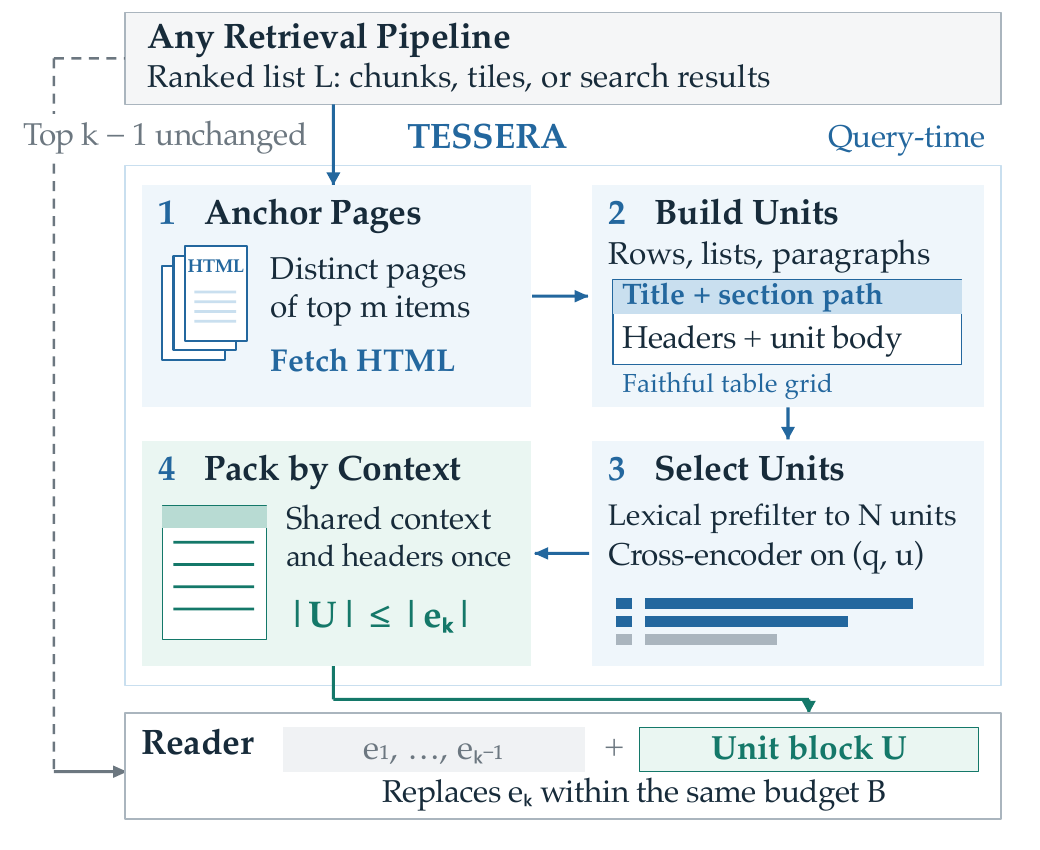
Tessera runs four steps at query time. It fetches the HTML of the distinct pages behind the top ten items. It parses each page into evidence units: a paragraph, a list item, a figure caption, or one row of a table or infobox. Each unit is completed with its page title, its section path (the chain of headings above it), and for table rows the column headers. Header resolution depends on a faithful grid, a table rebuilt so that merged cells (rowspan and colspan) occupy every position they cover. Pairing cells with the first header row in document order assigns a wrong header to, or drops the header of, 32.5% of the 2.9 million table cells on the study's anchor pages.
A lexical prefilter keeps the 100 units that share the most content words with the question. A cross-encoder, a model that scores a question and a unit together, ranks the survivors; Tessera reuses the pipeline's own reranker, BGE-reranker-v2-m3, so it adds no model. The packer groups the winning units by shared context, prints each title, section path, and header once, and fits the block into the slot of the last evidence item. The reader sees the top k-1 items unchanged plus the unit block, within the original budget. Nothing is retrained and the index is untouched.
Evaluation
The experiments use an August 2025 snapshot of English Wikipedia and 7,851 questions from Natural Questions [4], NQ-Tables [5] (questions whose answers sit in tables), and SimpleQA [6] (short factual questions with one verifiable answer). On a hybrid text pipeline that fuses dense and BM25 candidates, Tessera lifts pooled accuracy from 70.7% to 75.7%. On the released PixelRAG text and screenshot pipelines [2] the gains are 6.2 and 5.6 points. The gain is largest on SimpleQA (6.9 to 8.2 points), where long-tail facts often sit in infoboxes, and it stays between 4.6 and 5.8 points under four robustness checks.
Tessera beats all fourteen alternatives at matched cost. Retrieval-side methods such as query expansion, document expansion, and late chunking move pooled accuracy by about one point at most. RAPTOR [9] gains 1.2 points, and HtmlRAG [3] loses 0.4 to 0.7 points. Docling [10] and Unstructured, used as the unit builder inside the same delivery layer, gain 4.3 and 2.2 points against 5.0 for Tessera's own units.
The layer saves context as well. With 1,024-token chunks, 3K tokens with Tessera reach 76.1% accuracy, and 12K tokens of chunks reach 73.2%. On the screenshot pipeline, one tile plus a unit block at 2K tokens beats fourteen tiles at 12K by 3.4 points while using one sixth of the reader tokens.
Inside a multi-step search agent (Qwen3.5-4B calling a search tool up to eight times), Tessera raises accuracy on FRAMES [7], a benchmark of multi-hop questions over several Wikipedia pages, from 59.2% to 64.4%. The gain concentrates on tabular reasoning (+9.3 points) and numerical reasoning (+7.8). MuSiQue [8] questions are composed from single paragraphs that the top chunks already carry, and the gain there is 1.1 points. The agent also issues fewer searches and reads a shorter context (11.7K tokens against 12.8K).
Limitations
The experiments use English Wikipedia, whose pages are rich in tables and infoboxes and follow a consistent layout. The open web adds layout tables, client-side rendering, and noisier markup, and the unit builder has not been tested on them. Tessera also needs the page HTML at query time, so a deployment must keep a crawl snapshot or fetch pages live.
Tessera closes 54% of the accuracy gap that an oracle chunk holding the full evidence would close. Most of the remaining gap lies on pages outside the ten anchor pages and in units that the lexical prefilter drops. Widening the anchoring and replacing the lexical prefilter with a semantic one are the next steps.
- retrieval-augmented generation
- web retrieval
- structured evidence
- agentic search
Citation
@article{hua2026tessera,
  title={Tessera: Structure-Completed Evidence Units for Web Retrieval-Augmented Generation},
  author={Peichun Hua and He Sun and Zirui Zhuang and Qi Qi and Yiming Qiu and Shinan Liu and Yunming Xiao},
  journal={CoRR},
  volume={abs/2610.37080},
  year={2026},
  url={https://arxiv.org/abs/2610.37080},
  doi={10.48550/arXiv.2610.37080},
  eprinttype={arXiv},
  eprint={2610.37080},
  primaryClass={cs.IR}
}
References
- Patrick Lewis et al. Retrieval-Augmented Generation for Knowledge-Intensive NLP Tasks. NeurIPS, 2020. arxiv.org/abs/2005.11401
- Yichuan Wang et al. PixelRAG: Web Screenshots Beat Text for Retrieval-Augmented Generation. arXiv, 2026. arxiv.org/abs/2606.28344
- Jiejun Tan et al. HtmlRAG: HTML is Better Than Plain Text for Modeling Retrieved Knowledge in RAG Systems. WWW, 2025. arxiv.org/abs/2411.02959
- Tom Kwiatkowski et al. Natural Questions: A Benchmark for Question Answering Research. Transactions of the ACL, 2019. doi.org/10.1162/tacl_a_00276
- Jonathan Herzig et al. Open Domain Question Answering over Tables via Dense Retrieval. NAACL, 2021. arxiv.org/abs/2103.12011
- Jason Wei et al. Measuring short-form factuality in large language models. arXiv, 2024. arxiv.org/abs/2411.04368
- Satyapriya Krishna et al. Fact, Fetch, and Reason: A Unified Evaluation of Retrieval-Augmented Generation. NAACL, 2025. arxiv.org/abs/2409.12941
- Harsh Trivedi et al. MuSiQue: Multihop Questions via Single-hop Question Composition. Transactions of the ACL, 2022. arxiv.org/abs/2108.00573
- Parth Sarthi et al. RAPTOR: Recursive Abstractive Processing for Tree-Organized Retrieval. ICLR, 2024. arxiv.org/abs/2401.18059
- Christoph Auer et al. Docling Technical Report. arXiv, 2024. arxiv.org/abs/2408.09869