Published · ACSAC 2025
Securing On-device Transformer with Hardware Binding and Reversible Obfuscation
Overview
This paper studies active intellectual-property protection for transformer models deployed on edge devices. It binds model execution to hardware using physical unclonable functions and reversible weight obfuscation.
Method
PUF-derived keys control Arnold’s Cat Map-based transformations of model weights. Authorized hardware reverses the transformation for inference, while use with an incorrect key degrades model accuracy. The scheme is applied without retraining the original model.
Evaluation
The paper evaluates inference overhead and resistance to retraining, random key guessing, and encrypted-layer leakage attacks under its stated threat model. Its software artifact received Available, Reviewed, and Reproducible badges, as recorded on the author’s publication list.
ISCAS 2026 live demonstration
Live Demonstration: Hardware-Bound IP Protection for OWL-ViT on Edge Devices
The ISCAS 2026 paper demonstrates the ACSAC 2025 hardware-binding approach on OWL-ViT for open-vocabulary object detection on edge devices.
An NVIDIA Jetson Orin Nano performs inference while an Ultra96-V2 FPGA supplies an Arbiter PUF. Arnold’s Cat Map transforms attention weights, and row permutations transform feed-forward weights. A decrypt–infer–re-encrypt cycle restores and then re-obfuscates the weights.
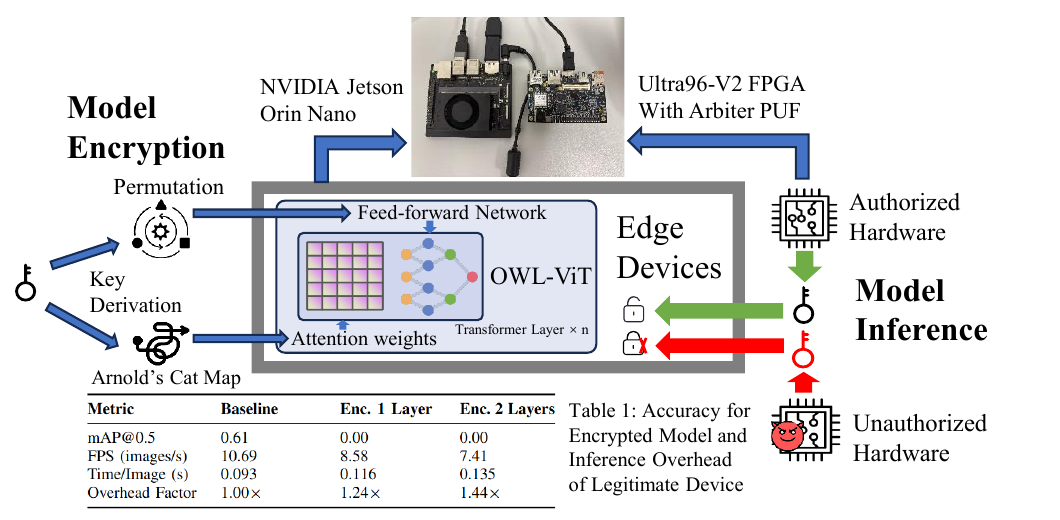
| Metric | Baseline | 1 layer obfuscated | 2 layers obfuscated |
|---|---|---|---|
| Detection mAP@0.5 (see note) | 0.61 | 0.00 | 0.00 |
| Authorized throughput (images/s) | 10.69 | 8.58 | 7.41 |
| Authorized time per image (s) | 0.093 | 0.116 | 0.135 |
| Authorized overhead factor | 1.00× | 1.24× | 1.44× |
For batches of eight images and 20 Pascal VOC classes, obfuscating one or two selected layers reduces unauthorized mAP@0.5 from 0.61 to 0.00. Authorized throughput decreases by 19.7–30.7% in the reported configuration. The demonstration extends the related ACSAC 2025 hardware-binding work.
- transformer security
- hardware binding
- physical unclonable functions
- reversible obfuscation
- model IP protection
Full paper citation
@inproceedings{hua2025securing,
  title={Securing On-device Transformer with Hardware Binding and Reversible Obfuscation},
  author={Hua, Peichun and Zhang, Hanxiu and Li, Tuo and Zheng, Yue},
  pages={956-972},
  booktitle={2025 IEEE Annual Computer Security Applications Conference (ACSAC)},
  year={2025},
  organization={IEEE},
  keywords={Deep learning;Computational modeling;Intellectual property;Transformers;Physical unclonable function;Hardware;Software;Data models;Protection;Software development management;Intellectual Property;Transformer;Model Stealing Attacks;Physical Unclonable Functions},
  doi={10.1109/ACSAC67867.2025.00079},
}